Funded Projects in This Area
Active sponsored research in this area.
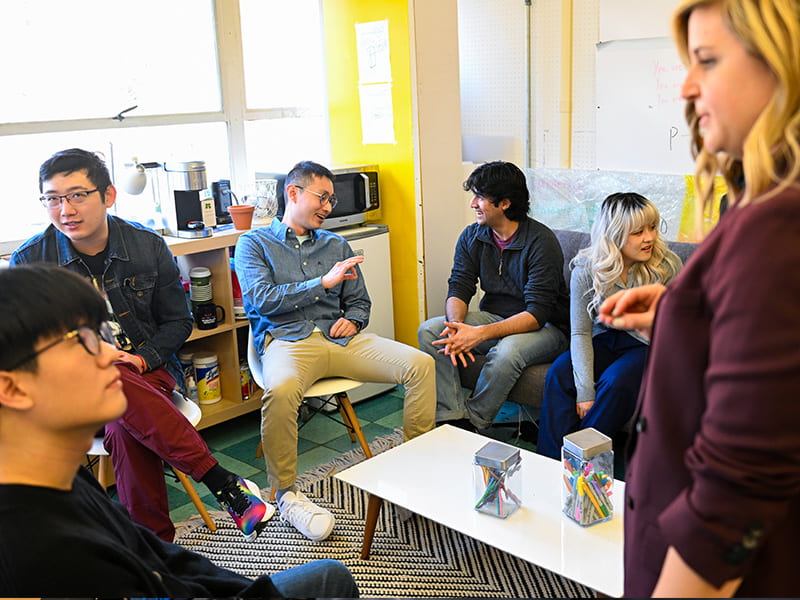
Inclusive Team Training
Training engineering student teams to build psychological safety, so better ideas actually reach the table
Overview
This five-year NSF-funded project turns britelab's longitudinal research on psychological safety into practical team training. Across studies of more than 500 first-year engineering students in 135 design teams, we linked psychological safety to idea sharing, the selection of creative concepts, and team performance over time. The project now scales those interventions — teaching teams to build safety early — to multiple campuses and universities, with measurable effects on how students collaborate.
Research Goals
- Train student teams to build psychological safety early in the design process
- Scale the inclusive teaming model to multiple campuses and universities
- Improve belonging and retention for students from underrepresented communities
- Develop data-driven approaches to team formation
- Create replicable frameworks other institutions can adopt
Impact
Psychological safety can be trained, not just hoped for. Teams that feel safe share more ideas and are more likely to select creative concepts — so teaching teams how to create safety is a direct investment in better designs and in keeping diverse talent in engineering.
Research Team
Funding
NSF ($1.4M grant)Related Publications
Completed Funded Projects
Past sponsored research that built this area.
National Science Foundation
Dr. Scarlett Miller (PI) · Dr. Kathryn Jablokow and Dr. Susan Simkins (Co-PIs)
Studied how team composition, climate, and communication patterns shape engineering design team performance, with findings that informed the lab's current inclusive teaming work.
Sept. 15, 2018 – Aug. 31, 2022$349,792Understanding the Impact of Product Dissection on Design Innovation and Learning
National Science Foundation
Dr. Scarlett Miller (PI) · Dr. Samuel Hunter (Co-PI)
Examined how physical and virtual product dissection influence design learning, cognitive load, and students' ability to generate novel engineering ideas.
Sept. 1, 2015 – Aug. 31, 2019$363,443National Science Foundation
Dr. Scarlett Miller (PI)
Developed research-backed ways to understand risk, creativity, and concept selection so designers can better identify and promote innovative ideas.
May 1, 2014 – Aug. 31, 2020$400,000National Science Foundation
Dr. Scarlett Miller (PI) · Dr. Samuel Hunter (Co-PI)
Built and tested statistical approaches for evaluating when creativity metrics are valid, reliable, and appropriate across different design problems.
Aug. 1, 2017 – July 31, 2020$214,147National Science Foundation
Dr. Scarlett Miller (Co-PI) · Dr. Nicholas Meisel (PI) and Dr. Timothy Simpson (Co-PI)
Investigated how formal additive-manufacturing learning experiences influence engineering students' design learning and creativity.
Aug. 1, 2017 – July 31, 2021$300,000National Science Foundation
Dr. Scarlett Miller (Co-I) · Dr. Karen Bierman (PI), Dr. Meg Small, Dr. Lynn Liben, and Dr. Jessica Menold
Designed and studied guided play experiences that help families support children's STEM learning, creativity, collaboration, and problem solving.
Sept. 1, 2018 – Aug. 31, 2021$1,264,388Understanding Malevolent Creativity in Terrorist Attacks: A Focus on Fixation
National Counterterrorism Innovation, Technology, and Education Center
Dr. Scarlett Miller (PI)
Explored how fixation shapes harmful idea generation in security contexts, connecting design-cognition methods with counterterrorism research.
July 1, 2020 – June 30, 2022$94,083Malevolent Creativity: Malicious Ideation and the Metaverse
National Counterterrorism Innovation, Technology, and Education Center
Dr. Scarlett Miller (PI)
Studied malicious ideation and emerging virtual environments to understand how technology can change harmful creativity and threat development.
July 1, 2022 – June 30, 2024$151,527U.S.-Tunisia-Morocco Partnership: Technology Innovation and Entrepreneurship Stimulation (TIES)
U.S. Department of State
Dr. Scarlett Miller (Co-PI) · Dr. Namiko Ounaies (PI) and Dr. Mostafa Shouman (Co-PI)
Supported international technology innovation and entrepreneurship programming connecting Penn State with partners in Tunisia and Morocco.
Aug. 20, 2012 – Dec. 31, 2014$198,000