Problem / Research Question
How can we train physicians to place central venous catheters safely and consistently — before they ever touch a patient?
Why It Matters
Mechanical complications such as arterial puncture, pneumothorax, and failed needle insertion are common in central line placement and put patients at serious risk. Better, objective training directly reduces preventable harm.
What britelab Is Doing
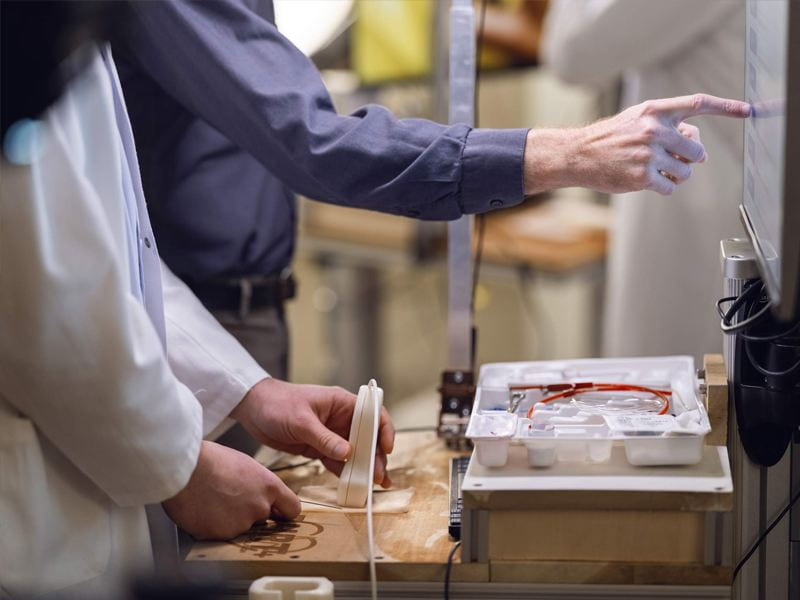
Successful training of medical residents to perform Central Venous Catheter (CVC) placement is of critical importance to ensure patient safety. Mechanical complications including arterial puncture, pneumothorax, hemothorax, and failed puncture commonly occur in CVC procedures. This project develops, explores the effectiveness, and implements the novel training method of dynamic haptic robotic training (DHRT) — utilizing a commercially available haptic robot programmed to apply forces to the resident's hand to mimic actual needle insertion.
- Develop dynamic haptic robotic training for CVC placement
- Reduce mechanical complication rates at partner hospitals
- Integrate AI/ML for automated real-time performance assessment
- Scale training across multiple hospitals including Hershey Medical Center and Cedars Sinai
Methods & Technology
Research Team
- Dr. Scarlett Miller (PI)
- Dr. Jason Moore (PI)
- Yuyuan Cao
PhD Student, Industrial Engineering
Alumni
- Dr. Jessica González Vargas
Asst. Professor, Mississippi State University
- Dr. Haroula Tzamaras
Human Factors Engineer, CarliMed
- Dr. Hong-En Chen
Human-Performance Engineer, Exponent
- Dr. Mary Yovanoff
Funding Agency
NIH National Heart, Lung and Blood InstituteCollaborators
- Dr. Sanjib Adhikary
Penn State Health
- Dr. Philip Ng
Cedars-Sinai Medical Center
- Dr. Lisa Sinz
West Virginia University Medicine
- Dr. David Han
Past collaborator · Professor Emeritus, Surgery & Radiology, Penn State
Partner Sites
- Penn State Health Milton S. Hershey Medical Center
- Cedars-Sinai Medical Center
- WVU Medicine
Outcomes / Impact
Over 1,000 physicians trained to date with 200 new physicians trained annually. Published research demonstrates significant reduction in placement errors and complications including infections and blood clots.
Related Publications
All lab publications →Related News
- $3.7M NIH grant to further improve patient safety in central line placements
Penn State News · Oct 15, 2026
- Novel robotic training program reduces physician errors placing central lines
Penn State News · Apr 17, 2024
- Penn State researchers showcase lifesaving medical technology
WTAJ · Apr 24, 2020
- Robotic training could help to decrease catheter placement complications
Penn State Health News · Oct 25, 2019
- Dynamic haptic robotic training to decrease catheter procedure complications
Newswise · Oct 22, 2019
- Medulate wins top prize at TechCelerator graduation
Centre Daily Times · Dec 11, 2018
- New needle simulator could train medical students to have a steady hand
Smithsonian Magazine · Jul 5, 2018
- Low-cost needle simulator aims to revolutionize medical training
Penn State News · Jul 5, 2018
- NIH grant will support robotic training for catheter insertion
Penn State News · Mar 27, 2015
Collaborate With Us
Sponsors, faculty collaborators, clinicians, and journalists interested in Central Line Simulation are welcome to reach out.
Contact Dr. MillerMore in Immersive Simulation & Medical Training