Problem / Research Question
Can a sensor-embedded training system help physicians find more polyps and perform colonoscopies more safely?
Why It Matters
More than 19 million colonoscopies are performed in the U.S. each year and up to 28% of polyps are missed. When colorectal cancer is caught early, 90% of patients live five or more years.
What britelab Is Doing
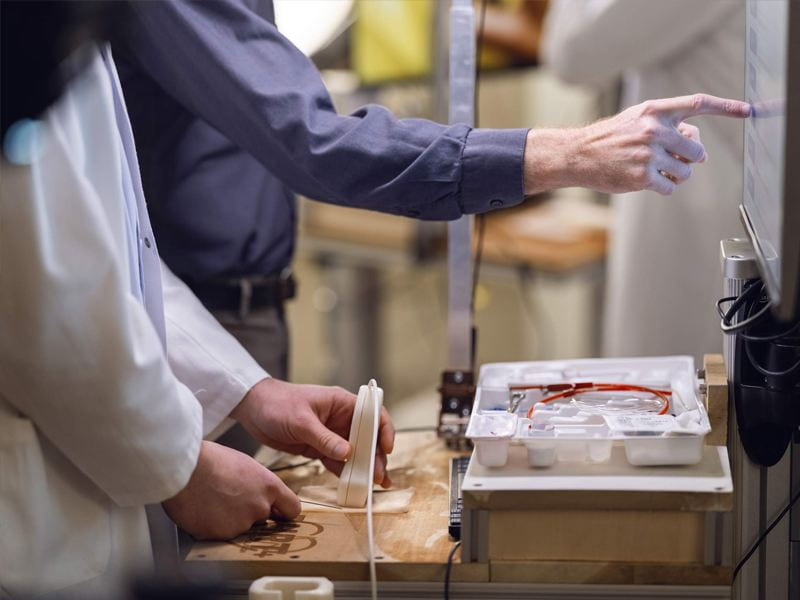
A novel colonoscopy training system that integrates automated personalized learning with a manikin embedded with sensors to help make the routine procedure safer, more accurate and cost-efficient. The system utilizes a real endoscope with force feedback, enabling trainees hands-on experience with the very same device they will use clinically. Over 19 million colonoscopies are performed in the U.S. each year, and up to 28% of polyps are missed during screening — this project aims to close that gap.
- Develop sensor-embedded manikin with automated performance feedback
- Improve physicians' ability to identify and locate polyps
- Provide force feedback to trainees to prevent colon wall perforation
- Deploy and evaluate the training system at Penn State College of Medicine
Methods & Technology
Research Team
- Scarlett Miller
- Jason Moore
- Eric Pauli
- Randy Haluck
Funding Agency
NIH NIDDK ($1.7M grant)Collaborators
- Eric Pauli
Penn State College of Medicine
- Randy Haluck
Penn State College of Medicine
Outcomes / Impact
Early detection from preventative screening through colonoscopies can drastically improve outcomes for colorectal cancer. When caught at an early stage, 90% of adults diagnosed with colorectal cancer live for five or more years. This training system aims to significantly improve polyp detection rates.
Related Publications
All lab publications →Related News
- Student success in engineering improved patient outcomes
Penn State News · Oct 10, 2024
- Re-engineering medical simulation training for the next generation of physicians
Penn State News · Aug 12, 2024
- Medical Simulation Training Improves Healthcare Outcomes | Augmented Reality in Medical Education
Penn State University (YouTube) · Aug 2, 2024
- Q&A: Enhancing physicians' colonoscopy training for early cancer prevention
Penn State Engineering · Nov 15, 2023
Collaborate With Us
Sponsors, faculty collaborators, clinicians, and journalists interested in Endoscopy Simulation are welcome to reach out.
Contact Dr. MillerMore in Immersive Simulation & Medical Training